Author Archive
May 18, 2013
One UK Mini Fastnet race finished and stroked off of the list! 17 boats started the race and only 7 finished! I am now officially fully qualified for the 2013 Mini Transat Race. Stay tuned for a full account of the trials and tribulations of this year’s Mini Fastnet race.
Diane
May 12, 2013
The UK Mini Fastnet Race starts today! We’ve had a slight change of course. Rather than going west to east, we’re going east to west……woohoo! Watch Andrew and I on the Yellow Brick tracker go around Fastnet Rock in 25 knots of upwind bashing!
Diane
May 11, 2013
The UK Mini Fastnet Race starts tomorrow May 12, 2013 at noon! There will be a small in port race and then we will storm off to the Fastnet rock and up the Irish coast to the Conninberg Light and then back to Plymouth England. It’s going to be 560 miles of double handed upwind madness! Check out Andrew and I on the tracker and everyone else trying to finish this epic race. This is my final qualifying event to be fully qualified for the 2013 Mini Transat race. See you on the start line!
Diane
May 10, 2013
The UK Solent Race started in the north west corner of the isle of Wight with beautiful sunshine and 12 knots of wind to lead us out and around the island.

At the start line we had a short upwind leg and then made then hoisted our big kites for an amazing run to the east. We were second to the weather mark and first to get our kite up.

Then the Pogo2s really kicked in gear. Each production boat has their strengths and weaknesses. Our Zero is fast in light upwind work. Off the breeze and in the breeze unfortunately the Pogo2 is faster. The prototypes of course are WAY faster off the breeze. Check out this video of Mad Dog moving into the passing lane, flashing his lights and blasting off passing a Pogo 2 like it was standing still!
http://www.youtube.com/watch?v=c_WdmxZaeHQ&feature=player_embedded
Next up we headed out to Poole. Here the wind got light…..too light. In the dark we just barely made it around the channel mark and the last of the breeze completely cut out. Unfortunately, the current was moving north east and was starting to speed up. Then we started to slide north,….back over the area we just sailed through! Quick…throw the anchor…..we’re going the wrong way! With the anchor set we decided to get a bit of sleep before the wind and current shifted and we were off again. Just at daylight the breeze built in and we were sailing around our anchor. Time to go! Andrew diligently started to lift the anchor. We were only in 30 feet of water and this should have been an easy task. Except when we tossed the anchor, it didn’t grab on the sandy bottom. Instead, it grabbed on the cross line of two crab pots that anchors them down to the bottom. As we pulled the anchor up we exposed the cross line of the pots and realized why it was sooooo heavy! UGH! With a quick capsize of the anchor while holding the cross line we were free and on our way. The other boats were mostly in sight, except for YellowFin. Yellow Fin was the other zero in the race. They had managed to get around the mark just before the wind died and kept their little upwind pocket rocket going and really legged out on the fleet. Our next leg took us to Eddystone….well, it took the rest of the fleet to Eddystone. The morning of the race start the course was posted. The course had been ammended slightly from the original information and Eddystone was added as a mark to take to Port. We didn’t realize that until it was almost too late, but we made a quick douse of the kite and climbed our way north and got around the mark. Unfortunately this put almost twenty miles between us and our competition! Time to start working our way back up the fleet. Throughout the rest of the race we were focused and kept pressing. We had loads of kite flying time in 20 knots of wind. With our small spinnaker up and a reef in the main we lost count of how many times we hit 14+ knots of boat speed! Andrew and I got around the western mark Wolf Rock, did a few tacks while the new breeze and 25 knots of wind built in on the nose. The waves built up and the sea got very very lumpy! Then the wind started to shift to the right and we really put the pedal down. Of the twenty miles we lost to Artemis, we gained back around 15, crossing the finish line just after Artemis and ahead of Blue One. Next up is the UK Fastnet race and our final leg of this qualifying journey for the 2013 Mini Transat race across the Atlantic Ocean. The Fastnet starts on Sunday May 12th.
May 4, 2013
One mast fixed with a new cast fitting for the spreader bracket! Good to go for tomorrow’s UK Solent Race. Follow us on the Yellobrick trackers 🙂

Diane
May 4, 2013
We’ve had a “minor setback”! Looks like the top spreader bracket decided to hold on just until reaching the dock in Lymington. It’s now broken in two pieces. Fortunately I have a spare and we’ve just come back from picking up the van in France, and have brought the spare bracket with us on the overnight ferry. It’s going to be a massive push to pull the rig off of the boat, remove the two brackets and sleeve on the new one, but Andrew has prepped everything and we should be good to start work as soon as I get there!
Diane
May 2, 2013
The UK Solent Race starts on Sunday May 5, 2013.
 This will be a 290 mile race, double handed, through the Solent and out to Plymouth. Yet another epic navigation race! The tides in the Solent are famous. They squeeze massive amounts of water around the Isle of Wight sometimes at a rate upwards of four knots! Plus there are all the rocks, traffic and local wind effects that we all know and love so much! This is where the famous Cowes Week and RORC Rolex Fastnet Race all live and breath.

Our course starts in Lymington. With a lap around the isle of White we’ll head up through the Solent to the East and around No Man’s Land, a fort built in the late 1860s to protect Portsmouth at a small cost of about a half million pounds. Then it’s off to my friend The Needles! I should be able to see it this time in the daylight hopefully. Then it’s out to the English Channel to Wolfe Rock 
where we make the big turn back up to Plymouth to finish the race.
This course may only have 11 boats registered, but the competition is going to be fierce. Almost everyone, with the exception of a couple of French boats, is a local. Born, bred and raised here, they cut their teeth on these tides and banks.
To keep up with all the fun and festivities, follow the race with the boat trackers. The trackers will come online probably the night before the race starts, but here’s the link.
Here’s the motley crew you’re all becoming familiar with.

Andrew my co-skipper is on the left and then myself. Katrina is holding strong next to me with her blue jumper on as she has lost her blue hat and is still waiting for her replacement blue hat to come. Then we have Nikki on the right anxiously waiting for the picture to be taken so she can get up her mast and sort out a few “wiring issues”. We’re almost ready to go!
Diane
April 30, 2013
Through rain, sleet, hail, becalmed against tide and massive cargo ships in the English Channel…..nothing could stop us! Katrina and I have sailed our boats up from Pornichet France to Lymington England. As usual, life and the delivery was filled with fun and excitement. The 320 mile run had us becalmed in two spots while we were against the tide, which wasn’t….as Katrina said “wasn’t in the brochure”. The first time was in the channel between Belle Ile and Quiberon. We must have sailed back and forth for two hours. The next becalmed spot was just before going around the outside of Ile D’ouessant and breaking out into the English channel. It was so calm and still that I literally slid backwards and lapped myself…loosing almost three miles! Not to mention that the boat was SOOOOO loaded with equipment, that I think we were sitting a full inch deeper in the water and incredibly slow for it. We also had two moments of hail. At one point the deck was completely covered in hail and slush! Gotta love wearing a dry suit….even if it’s in hail. Finally, we had a fantastic crossing of the English Channel. There was loads of traffic but the Icom AIS worked beautifully alerting me to all the traffic and where it was going. The last part of our adventure was coming into Lymington. Lymington is up the river in the Solent. You enter this whole mess at The Needles. This is The Needles.
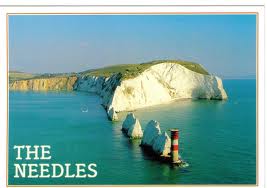
The only complication to this part of the delivery was actually getting up past the Needles and into the Solent….in the dark…..without a full proper chart! Katrina received a special order of charts the day before we left. The only problem was that they actually missed the chart of the Needles and the Solent. So we had to manage with the information in the Almanac and a screen shot of the chart off of her phone!

Entering looks simple enough on the right, but a little scary if you get too close. On the other hand, off to the left is a mass of underwater obstructions that looks like this. Underwater obstructions at less than a meter, rips, tide, race marks and a narrow little channel to get in. Plus, we were going to arrive at night with the wind possibly on the nose. Luckily when we did get there we could just fetch the channel…. barely and we still had the tide with us rather than against! I had to use a sector light to follow, multiple cardinals and channel marks. If the wind had been any further left, I would have had to tack back and forth while watching sector lights. Complicated to say the least! But, I had Katrina behind me in her boat, who had been through dozens of times, and my anchor at the ready if things went pear shaped. Slowly we made our way up the channel. The appropriate lights were on either side of me and the sector light was white..Phew! ok, crack off a little to give some breathing room. Woops! The sector light almost instantly went green…..too far right…gotta tighten back up right away! Slowly the sector light went back to white and all was good. Past the first mark….then the next and the next. Our tow boat and race organizer was on the other side ready to take us up the river to our new home for the next few days. Never a dull moment!
Follow the UK Solent race starting on Sunday!!!
Diane
April +26, 2013
Delay of Game! We’re waiting one more day for a better weather window….to head to England. It will be mostly reaching in the rain rather than upwind in 20 knots! waayyy better plan!
Diane
April 25, 2013

The Pornichet Select race is a 300 nautical mile race from Pornichet, out to the Bay of Biscay, down to Les Sables d’Olonne’s famous “Nouche Sud” mark of the Vendee Globe, and back up to Pornichet. Throughout the route you have to leave different islands and navigational marks to specific sides and you also have “option” on Belle Ile and the hazards of Quiberon. This year’s race also had the excitement of an exclusion zone from Lorient out to the Plateau Des Birvideaux and up to Quiberon. The military were using it as a firing range and asked us to stay out! No Problem!!!
Ultimately though, this race was a navigator’s race. Throughout all of those islands there are tidal streams running in different directions and at significant rates, rocks that could really ruin your day and various coastal shoreline effects….all critical factors in executing a plan for a race.
We started off with a short upwind mark in the Bay of Pornichet and then headed out for our first run north. It was sunny, 5-10 knots of wind with some light spots and 65 boats all screaming off into the Bay of Biscay hungry for miles! The run north gave us our first tactical “gate”. The tidal gate is the “moment of opportunity” to get through the current in the most positive effect. The gate “closes” when the tide turns and becomes an adverse current.

The “gate” on getting up the inside of Quiberon and out through the narrow passage was tight, but manageable if you were at the front of the pack. If not, going on the outside in the channel between Belle Ile and the hazards of Quiberon was a better tactical advantage if you avoided the shoreline of Belle Ile and the current running from north to south.
I was positioned further back in the pack so rather than risk the gate, I chose to go up the channel on the east side on our way to our first turning mark. When we joined up with the pack coming out of the Quiberon channel, we were in a decent position heading to Birvideaux. The run up the channel saw some afternoon localized thermals and we had good breeze to go upwind….and move the stack every time we tacked. Moving the stack is critical in a mini. OGOC is a production boat and that means we weigh about two thousand pounds….only. With all the sails, safety equipment, food and water, tools plus plus plus down below, there is an easy two hundred pounds of equipment that can all be stacked inside the boat to the weather side to help equate the weight of crew sitting on the rail. The boats are also shaped like a triangle, so it’s easy for them to pitch like a hobby horse. Being able to move the weight around means streamlining the boat as it goes through the water and gives you optimal power in your sail trim. Soooo……we move the stack every time we change tacks.
After coming around Birvideaux my routing showed a short kite run of about 10 miles to get around the outside of Belle Ile, going into the night. MMMMMMMM J The first night run! I love racing at night! But here the wind was going to get light and move forward. An awesome chance to get our big big gennaker up. We passed 7 or 8 boats in the night. Boat speed and focus was key of course, but having a nice fat gennaker didn’t hurt either! Most of the other boats have a gennaker that is small and flat. This allows them to run their gennaker in the 70-90 degree true wind angles and in heavier wind. Mine is too deep and big and worn out to manage, but these conditions on the other hand….were perfect! Up the gennaker went and we started to build boat speed. Slowly but surely the lights on the other boats got bigger. As I passed them I could see that some were having troubles, some had the wrong sails up and some were just slow! Woohoo, here we go! In the morning, there were a whole new set of boats around us and the wind was building to a gentle 10-15 knots. We were now on our way to La Nouche Sud….the famous finish line mark for the Vendee Globe! Our big blue spinnaker was up and the boat felt great. Here we started to slow down a little though compared to the boat speed of our competitors, but we were still holding our own. But wait….where is that darn mark? There was a bunch of traffic with people going in and out of Les Sables making it difficult to see the mark. Fortunately the waypoint was perfect. By the time I got into the last mile to the mark, I could clearly make out the committee boat and the cardinal mark. Now for the hard part!

The next leg was all the way back up to Ile De Groix (Lorient)….but it was upwind all the way. 100 miles of bucking upwind, tacking, stacking and trying to meet the next tactical opportunity. There were two. The first was whether to go left or right coming out of Les Sables. I hadn’t determined a significant plan for this, other than to try to get into a good phase with the wind shifts. There was a thermal again and the wind would shift back and forth through ten or fifteen degrees through the first leg to Ile D’Yeu. The second gate or tactical spot was coming to Belle Ile. You could pass on either side of it. Here the wind was going to get very very light. Current became a critical role. If the choice was to go outside of Belle Ile, you had to go at least three or four miles out to get the good wind. If you stayed close to the Island you had to really hug the shoreline to catch the extra bits of wind stuck to the shoreline. BUT you had to make sure that the current didn’t push you the wrong way! The other option was to go inside Belle Ile again. Depending on the timing for getting to the inside of the island, this might give a tactical advantage of catching a positive current while the current on the outside of the island was still pushing on the beam. As I got closer to the island, my competition from behind was starting to catch up! I couldn’t find the boat speed.
OGOC has been known to have things latch on to her keel, so I started to think that we had a big seaweed monster that had hooked on for a ride, but nevertheless, these boats were catching up. So, I decided to take the risk of running inside Belle Ile. Short course racing is very different from offshore racing. In course racing, when you’re behind, you often execute the “we’ve got nothing to loose if we split from the fleet” option. But, in long offshore racing, it often doesn’t pay and costs you significantly. In offshore racing you are often better to stick with the pack and take advantage of other boats’ errors as opportunities to catch up. Someone puts the wrong sail up, has a nap…whatever the case may be, but those are the moments to capitalize on. Here is where I learned a very valuable lesson. When I headed for the inside of Belle Ile, the current took me east very quickly. But, I wasn’t quite at the tip of the island yet. Because I was going upwind, I only had the option of being on starboard tack which took me outside of the island, or port tack which took me inside the island with the current. The current was too strong. I slid east, but wasn’t making any movement forward. Then when I realized how much this wasn’t going to work, I had to start clawing my way back out to the west of the island, with the current pretty much on the nose! Very slow to say the least and more boats caught up. By the time I got around the deepest part of the island, my position was pretty locked in at the back of the pack and I was going to have to start clawing my way back up again, with very little race course left to gain miles.

At the beginning of the race, my buddy Chris said to me “hey, if we end up beside each other, why don’t we do some speed testing?” Ironically enough, this was going to be the pattern for the rest of the race. Chris and I met up at the fattest part of the island and the speed testing started as we both tried to pass each other and gain an advantage. We were going upwind, and just able to fetch the next island. At Ile De Groix, we would turn around the island in the dark and make our way to the finish line another 50 miles away. The chase was on! Bearing away around the island I put my big fat gennaker up again and started to slide past Chris in the dark. It would only be a few miles before we would bear away to a wind angle worthy of the big spinnaker, but I had to risk it. The gennaker would go up and then I would have to do another sail change. OGOC only has one jib halyard and one masthead halyard for the gennaker and the spinnakers. A sail change means running down wind with only the jib up until everything gets swapped over. Slow for sure, even with as many sheets and things preloaded as possible. Sure enough, we started to slide past Chris with the gennaker. Then he put his big kite up…..and started to pass us as I pulled my gennaker down and did my sail change. Then with our big blue kite up we started to catch up again! Our positions swapped back and forth many times until we made our way to the final leg to the finish. For those of you who do offshore racing on Lake Ontario, you will be very familiar with the consequences of finishing a race very very early in the morning as the sun starts to come up. As the sun comes up and starts to heat the shoreline, it causes an inversion with the night breeze and usually creates a dead zone of no wind right at the finish line. I’ve finished many many a race coming into Port Credit, desperately trying to get across the finish line before the last of the night breeze is crushed by the heat of the morning sun. Well……apparently it’s no different anywhere else in the world! As we slowly made our way in to the finish line at the entrance of the Bay, the sun came up and the breeze died off to a gentle 3 or 4 knots. Then the fog settled in. Visibility became almost non existent and I lost sight of Chris. Every once in a while another boat would pop out of the grey and then they would be gone again. Time to just keep the boat going and gybe through no wind. When the big kite droops in no wind, it literally drags through the water and becomes a sea anchor. I think I gybed back and forth about thirty times that morning….almost all of them requiring me to go up to the bow, grab the wad of spinnaker and heave it to the leeward side of the boat.
Then, within about a mile and a half of the finish line, the fog started to break on the shoreline to my left! Woohoo! That means that there’s a little wind over there to push the fog! Gybe…heave spinnaker and head for the breeze! Wait…is that a black hull???? Through ten miles and all that fog and all that gybing, Chris and I came out of the fog at almost exactly the same spot! The last mile and a half were going to be a true test of who could avoid the rocks, gybe and keep the boat moving to the finish line! In the second last gybe, I thought my moment to capitalize had come. Chris went on a long gybe away from the finish line. I gybed inside but still behind. Gybing inside meant that I was pointing deeper downwind, but it also meant less distance to travel. The kite filled! Chris’ kite dropped! Talk about white knuckle moments! AND, we were only moving at about two knots! Chris was about five boat lengths ahead of me. Would the breeze give me an extra little push? Would his kite fill? Unfortunately it did. We both got a little puff at the same time, sliding him across the finish line just ahead of me. What a great race, right to the finish! As always, lessons were learned and we move up another rung on the offshore racing ladder! Next up…..we sail to ENGLAND TOMORROW! The UK Solent and the UK Fastnet….here we come! Follow Katrina and I all the way to the Solent on my tracker or our AIS. You can get the link for the tracker from my homepage. Or, if you want to follow the AIS, there are many many sites that can get you going….just google ship tracking 🙂 See you in England!
Diane
